

Relying on hotels for long-term project teams is a drain on your bottom line. It’s an unnecessary tax on your staff’s morale. With London hotel RevPAR projected to rise by 1.8% in 2026, traditional hospitality is no longer a viable project strategy. Implementing professional workforce housing solutions transforms your accommodation from a logistical headache into a strategic asset. Stop overpaying for cramped rooms. Start investing in environments where your team can actually rest.
Managing multiple tenancies is a burden that pulls your focus away from the site. You’re likely tired of the friction caused by rising operational costs and the lack of privacy for your contractors. This guide shows you how to source, evaluate, and manage professional team stays to reduce project overheads and improve productivity. We will cover the essentials of centralised booking, fixed cost management, and sourcing furnished homes that support long-term workforce retention.
Key Takeaways
- Understand why traditional hotel models are failing long-term infrastructure projects and how residential alternatives resolve these pressures.
- Master a 5-step framework for evaluating workforce housing solutions to ensure your team remains close to the project site.
- Compare the operational costs of managed stays against hotels to identify significant savings in your project budget.
- Learn the logistics of rapid deployment to source high-quality, fully furnished homes for scaling teams in record time.
- Reduce administrative friction by moving to a centralised booking system that handles the heavy lifting of accommodation logistics.
Why UK Infrastructure Projects are Shifting to Workforce Housing Solutions in 2026
UK infrastructure is expanding rapidly. Major rail and renewable energy projects require mobile, highly skilled teams. Historically, project managers defaulted to hotel blocks. In 2026, this model is failing. Rising operational costs in hospitality, coupled with a 4.1% increase in the minimum wage as of April 2026, have made nightly hotel stays a significant budget risk. Workforce housing offers a pragmatic alternative. These are not standard residential tenancies. They are professionally managed, fully furnished residential units tailored specifically for corporate teams.
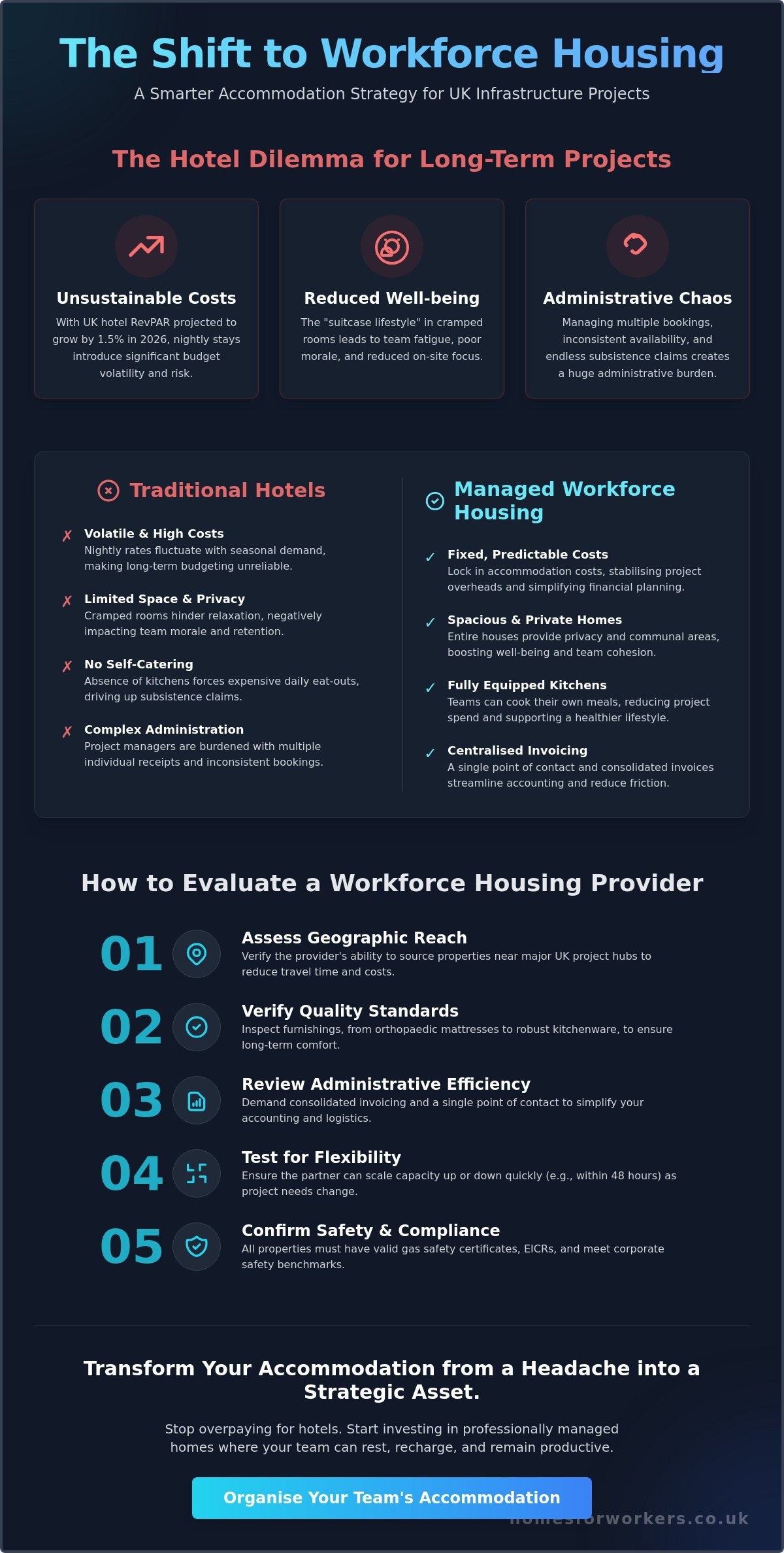
Transitioning to workforce housing solutions allows firms to stabilise project overheads. Hotel revenue per available room (RevPAR) is projected to grow by 1.5% across the UK throughout 2026. This volatility makes long-term budgeting difficult. Managed workforce housing provides fixed, predictable costs. It also solves the retention crisis. In competitive sectors like renewables and rail, the quality of life on-site is a deciding factor for contractors. A dedicated house provides privacy and comfort that a standard hotel room cannot match. It signals that a company values its workers’ well-being.
The Limitations of the UK Hotel Sector
Hotels introduce significant friction for long-term deployments. The absence of kitchens forces teams to eat out every night. This drives up subsistence claims and increases project spend. Availability is often inconsistent. Local events or seasonal tourism can displace your crew without warning. This creates logistical chaos for the project manager. Beyond the logistics, the “suitcase lifestyle” takes a heavy toll. Lack of personal space leads to fatigue. It reduces the focus needed for high-stakes engineering tasks on site.
Defining the Professional Managed Stay
A professional managed stay differs fundamentally from a casual holiday rental. It adheres to strict corporate safety and quality standards. Houses are selected for their proximity to project hubs and transport links. They are configured for crews of 4 to 10 people to maximise efficiency. Professional cleaning and regular maintenance are included as standard. This ensures the property remains in top condition throughout the deployment. It removes the need for project managers to deal with individual landlords. It provides a single, reliable point of contact for all accommodation needs.
How to Evaluate Workforce Housing Providers: A 5-Step Framework
Procuring accommodation for national infrastructure projects requires a rigorous selection process. It’s about moving beyond local landlords to find a partner capable of managing complex logistics across multiple sites. A structured framework ensures your workforce housing solutions meet both budget requirements and safety standards. This systematic approach allows project managers to outsource the heavy lifting while maintaining full control over the quality of the stay.
- Step 1: Assessing Geographic Reach. Verify the provider’s ability to source properties near major UK project hubs. Proximity to the site reduces travel time and fuel costs. A national footprint is essential for teams moving between different phases of a project.
- Step 2: Verifying Standards. Inspect the quality of fully furnished homes. Essential items like orthopaedic mattresses and robust kitchenware matter for long-term deployments. This isn’t a holiday let; it’s a professional environment that must be ready for immediate occupation.
- Step 3: Reviewing Administrative Efficiency. Efficiency is found in the back office. Managing fifty separate receipts for fifty different rooms is a waste of your time. Demand consolidated invoicing that maps directly to your project codes. This level of clarity simplifies your accounting.
- Step 4: Testing for Flexibility. Projects are rarely static. Your housing partner must be able to scale capacity up or down as crew numbers fluctuate. Ensure they can source additional units in a new region within 48 hours to prevent delays.
- Step 5: Safety and Compliance. Every property must have valid gas safety certificates and EICRs. Professional providers handle this documentation automatically. They ensure that every home meets corporate safety benchmarks before your team arrives.
Essential Amenities for Team Productivity
Modern site teams need high-speed WiFi for daily reporting and personal use. Ample off-street parking is equally critical for commercial vans and equipment. Kitchen and laundry facilities are the primary tools for preventing team burnout. They allow workers to maintain a healthy routine, which is impossible in a standard hotel room. These features directly support workforce retention by providing a sense of normality during long deployments.
Compliance and Risk Management
Using unregulated “spare room” platforms exposes your firm to significant risk. These properties often lack the necessary corporate insurance and safety checks. For teams of five or more people from different households, the property must strictly adhere to UK HMO (Houses in Multiple Occupation) licensing regulations. Partnering with a specialist for managed stay services ensures these legal requirements are met without your team having to track the paperwork. According to a National Housing Strategy analysis, designing an effective framework requires a deep understanding of these regulatory components. Professional workforce housing solutions mitigate these risks by providing fully compliant, project-ready homes nationwide.
Comparing Managed Housing Solutions vs. Traditional Hotel Stays
Hotels are built for short-term convenience. Projects require long-term stability. When you analyse the total cost of occupancy, the difference is stark. Professional workforce housing solutions offer a superior ROI by eliminating the inefficiencies of the hospitality model. For stays exceeding 30 days, switching from hotels to managed houses can reduce accommodation spend by up to 40%. This is a significant margin that can be reallocated to other project essentials.
This saving is driven by more than just the base rate. Hotels rely on ancillary revenue. They charge for laundry services, van parking, and premium connectivity. These costs are often hidden until the final reconciliation. In a managed residential setting, these facilities are part of the package. You secure a fixed, predictable cost for the duration of the project phase. There are no surprise fees for using a washing machine or parking a commercial vehicle.
The ROI of Self-Catering for Contractors
Subsistence claims are a significant variable in project budgets. A team of ten eating out every night creates a massive financial footprint. Providing a fully equipped kitchen changes the dynamic. It allows teams to prepare meals together, which lowers daily allowances and fosters better working relationships. It’s an essential part of an outsourcing contractor accommodation strategy. Shared living spaces encourage the kind of informal debriefs that improve site safety and coordination. It’s about creating a home environment that supports the physical and mental demands of the job.
Administrative Efficiency and Consolidated Billing
The administrative burden of hotel stays is often overlooked. Processing dozens of individual receipts every week is a drain on your resources. It leads to admin creep that pulls project managers away from their primary objectives. Managed providers act as a single point of contact for all logistics. You receive one consolidated invoice per month. Maintenance issues are handled by the provider, not your site office. If a boiler fails, you make one call. This streamlined approach ensures that your team stays focused on the build whilst the heavy lifting of your workforce housing solutions is managed elsewhere.
Implementing a National Housing Strategy for Rapidly Scaling Teams
Scaling a team across the UK is a complex logistical challenge. You need a strategy that moves as fast as your project. Relying on local estate agents for workforce housing solutions is inefficient. They lack the national reach to support teams moving between regions. A unified strategy ensures that whether your crew is in London or the North East, the standard of accommodation remains identical. This consistency is vital for maintaining team morale across a national portfolio. It removes the guesswork from your procurement process.
Rapid deployment is critical for infrastructure success. Projects often scale from a 5-man pilot crew to a 100-man workforce in a matter of weeks. You can’t wait months for property development or standard rental approvals. You need project-ready homes in under 48 hours. This speed prevents site delays and keeps your timeline on track. Managing this scale requires a partner who understands the pressure of a live site and the need for immediate results. It’s about having the capacity ready before the boots hit the ground.
Managing Logistics Across Multiple UK Sites
Local estate agents focus on long-term residential lets. They aren’t equipped for the rapid turnover of contractor teams. A national partner understands the specific needs of the built economy. They provide standardised furniture packs and flexible terms that local agents simply won’t offer. Centralising the workforce housing management process removes the friction of dealing with multiple points of contact. It ensures every property meets your specific corporate standards. This creates a reliable “home base” for your team, regardless of the project’s geographic spread. If you need to scale your accommodation today, book your team accommodation here.
The Future of Workforce Housing in 2026
The landscape in 2026 is defined by digital efficiency. Technology now streamlines everything from digital check-ins to maintenance reporting. There’s also a growing focus on sustainability. Energy-efficient housing helps firms meet ESG goals whilst reducing utility overheads. With the UK government backing the £39 billion Social and Affordable Homes Programme, the broader rental market is shifting. We monitor these trends to predict demand for upcoming rail and energy projects. The UK is currently facing a skills crisis in the construction sector. This means you’ll likely be moving specialist teams across the country more frequently. Proactive workforce housing solutions ensure your team always has a place to stay even when BTR occupancy sits at 97%.
Homes For Workers: Streamlining Your Workforce Accommodation Logistics
Homes For Workers operates as your behind-the-scenes fixer. We handle the logistical complexities of housing so your project team can focus on delivery. We provide fully furnished, project-ready homes across the UK. These aren’t generic rentals. They are specifically curated workforce housing solutions designed for the built economy. We understand the urgency of site mobilisations. Our team responds with speed and quiet competence. We take pride in handling the heavy lifting. This allows you to focus on your primary objectives without being bogged down by property management.
Our managed workforce housing services remove the administrative weight from your shoulders. We don’t just find a property; we manage the entire lifecycle of the stay. This includes everything from utility management to professional cleaning schedules. It eliminates the friction between project owners and individual property logistics. You get the stability of a residential home with the service level of a corporate provider. This approach reduces the total cost of occupancy and improves team retention. It’s a pragmatic solution for a fast-moving industry that demands reliability.
Why Project Managers Trust Homes For Workers
Project managers across the UK rely on us for large-scale team deployments. We’ve successfully mobilised housing for crews on major rail and energy infrastructure projects where timing is critical. For us, team accommodation is a specialised discipline. It isn’t a side-line to residential lettings or a secondary service. We focus exclusively on the needs of corporate teams and the contractors who support them. For a deeper look at our methodology and how we support the built economy, read our team accommodation pillar. This comprehensive guide details how we optimise housing for 2026 project requirements.
Getting Started with Your 2026 Project Housing
Securing your next site base is a straightforward, methodical process. You provide the location and the crew size. We handle the site-specific sourcing. We evaluate the local market to find the best-fit properties for your specific timeline. Once sourced, we manage the ongoing maintenance and logistics. This ensures your team moves into a compliant, fully functional environment from day one. Our workforce housing solutions are designed to be scalable and flexible. We adapt as your project grows. Don’t let accommodation logistics delay your next project phase. Contact us today to secure your team’s housing and streamline your deployment for the year ahead.
Future-Proof Your Project Logistics
Professional residential stays represent a significant shift in how modern infrastructure projects are managed. You now understand the financial advantages of moving away from hotels and the importance of a structured evaluation process. These houses provide more than just a bed; they offer the self-catering facilities and privacy required to maintain a high-performing team. By centralising your logistics, you eliminate the administrative creep that often stalls project momentum.
Homes For Workers acts as your dedicated partner, providing a fully managed national service with specialist support for UK infrastructure projects. We handle the complexities of property sourcing and maintenance whilst offering consolidated monthly invoicing for your peace of mind. Implementing reliable workforce housing solutions is the most effective way to protect your budget and your people. Secure your workforce housing solution with Homes For Workers today. We are ready to handle the heavy lifting so your team can focus on the build.
Frequently Asked Questions
What is the difference between workforce housing and standard residential lets?
Workforce housing is a managed stay service designed for corporate teams, whilst standard lets involve long-term tenancies and unfurnished units. Our properties are project-ready from day one. They include all utilities, professional furnishings, and ongoing maintenance. Standard residential lets often require 12-month commitments that don’t suit project timelines.
Can workforce housing solutions accommodate teams of 20 or more?
We accommodate large workforces by securing multiple properties in close proximity. This allows teams of 20 or more to live near the project site whilst maintaining the privacy of smaller group houses. It is a scalable approach to workforce housing solutions that provides more flexibility than traditional hotel blocks during long-term deployments.
How do you ensure the quality and safety of properties across the UK?
We maintain quality through a centralised management process and regular maintenance schedules. Every property undergoes rigorous safety checks, including gas safety and electrical inspections. For teams exceeding five people, we ensure the property meets all local HMO licensing requirements. This protects your firm from regulatory risk and ensures a high standard of living.
Is workforce housing more cost-effective than booking hotel rooms for long stays?
Managed housing is significantly more cost-effective for stays exceeding 30 days. You avoid the high nightly rates of the hospitality sector and the hidden costs of subsistence. Fixed pricing allows for predictable budgeting. It removes the volatility of seasonal hotel price hikes and eliminates expensive laundry or parking fees.
What amenities are typically included in managed contractor accommodation?
Our fully furnished homes include high-speed WiFi, laundry facilities, and fully equipped kitchens. Ample parking for commercial vans is a priority during our sourcing process. These amenities are essential for reducing team burnout on long-term deployments. They allow your crew to maintain a healthy routine away from the site.
How much notice is required to scale up our housing requirements for a new project?
We typically require 48 hours to mobilise workforce housing solutions for new project phases. Our national network allows for rapid deployment even in high-demand infrastructure hubs. This speed ensures your site mobilisation stays on schedule. It prevents delays caused by accommodation shortages in local markets.
Do you provide consolidated invoicing for multiple properties?
Yes, we provide one consolidated monthly invoice for all properties under your management. This removes the administrative burden of processing dozens of individual receipts. It simplifies project accounting and allows your project managers to focus on site delivery. Every invoice is clearly mapped to your specific project codes.
What happens if our project timeline changes and we need to extend the stay?
Our managed stay services are designed for the fluid nature of infrastructure projects. We offer flexible extension options to accommodate shifting timelines and project delays. You aren’t locked into rigid residential contracts that penalise changes in your schedule. We work with you to ensure your team has a stable home base until the job is finished.