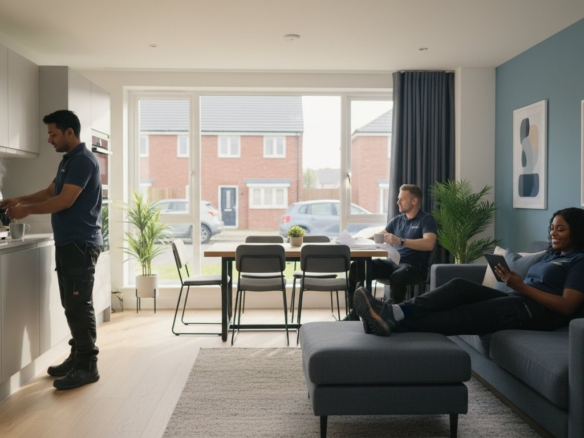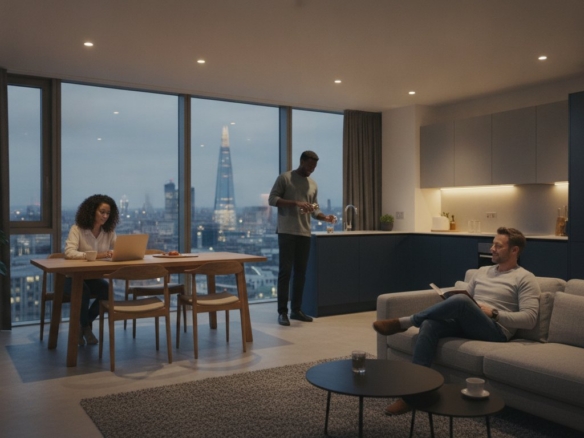


The median booking lead time for corporate housing has dropped by 42% in just twelve months. This shift reflects a high-stakes environment where speed and efficiency are non-negotiable. You already know that relying on expensive, cramped hotel rooms for long-term staff accommodation is a drain on your project’s bottom line. The administrative burden of managing multiple tenancies only adds to the friction. It’s a logistical headache that often leads to poor workforce morale and reduced productivity on site.
Securing the right housing is no longer just a facility requirement; it’s a strategic asset. This guide provides a comprehensive roadmap for 2026 to help you lower project overheads and secure ready-to-occupy homes near your site. You’ll discover how to transition from hotels to managed stays to improve workforce well-being across the UK. We also examine how to simplify your invoicing and why new technical standards like Wi-Fi 7 are now essential for modern project teams. We’ve handled the heavy lifting so you can focus on delivery.
Key Takeaways
- Distinguish between serviced apartments and HMO models to select the most efficient housing for your specific crew size.
- Calculate the tangible ROI of staff accommodation by comparing high hotel costs against the stability of managed, fully furnished homes.
- Improve workforce retention by prioritising essential amenities and self-catering facilities that support long-term health and morale.
- Navigate UK health and safety compliance with ease by understanding the mandatory standards for professional workforce housing.
- Streamline multi-site operations by centralising your sourcing and management through a dedicated specialist provider.
What is Staff Accommodation in a Corporate Context?
Professional staff accommodation is a strategic management tool. It moves beyond the simple provision of a bed, representing a turn-key managed stay service designed specifically for the logistical needs of a professional workforce in 2026. Unlike traditional residential lets, these solutions are built for speed and operational flexibility. They bridge the gap between temporary lodging and permanent residency, ensuring that workers have a stable environment to perform their roles effectively. This concept of Workforce housing is now a central pillar of project planning for any firm operating away from its home base.
The term is broad but distinct from other housing models. Understanding the differences is vital for compliance and cost control:
- Tied Accommodation: Housing provided by an employer that is mandatory for the job, often found in agriculture or on-site caretaking.
- HMOs (Houses in Multiple Occupation): Large residential properties where at least three people from different households share facilities. These require specific licensing and safety standards.
- Fully Furnished Team Housing: The preferred modern standard for contractors. These homes offer a “home from home” experience with self-catering facilities and professional management.
In 2026, the market has shifted decisively towards project-based lodging. Businesses no longer want to be tied into long-term residential tenancies that don’t align with project timelines. They need staff accommodation that can scale up or down as a project reaches different milestones. This includes everything from rapid deployment units for emergency utility repairs to long-term contractor housing for multi-year infrastructure builds.
The Evolution of Workforce Housing in the UK
The UK has moved past the era of informal “digs” and unmanaged guesthouses. Modern infrastructure projects demand corporate housing for teams that functions as a professional extension of the workplace. High-speed connectivity is now a baseline requirement. With Wi-Fi 7 becoming the expected standard for professional stays this year, housing must support the multi-gigabit speeds needed for remote reporting and team coordination. Managed stay services have replaced the “accommodation allowance” model, giving companies better oversight of their duty of care obligations.
Key Industry Sectors Utilising Staff Housing
Several high-growth sectors now rely on managed housing to maintain their momentum. The demand is particularly high in regions like the Southeast, where manufacturing and automotive industries are expanding rapidly. Key sectors include:
- Renewable Energy: Solar and wind farm construction requires the rapid deployment of large teams, often in remote locations with limited hotel capacity.
- Civil Engineering: Major rail and road works require mobile workforces that need to be housed near shifting site locations to reduce commute times.
- IT and Consultancy: Corporate relocation housing for specialist consultants on three to six-month contracts.
By outsourcing the “heavy lifting” of sourcing and management, these sectors ensure their teams stay focused on delivery rather than logistics.
Comparing Models: Which Staff Housing Solution Fits Your Project?
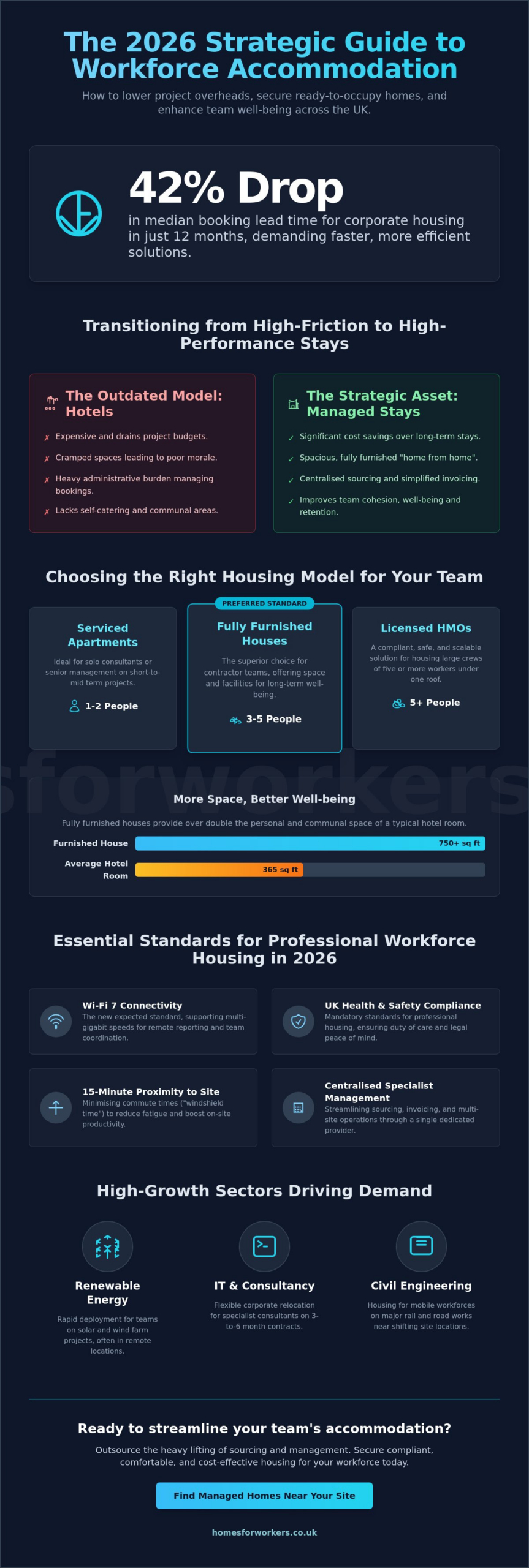
Selecting the right staff accommodation model is a critical project milestone. It isn’t just about finding beds. It’s about matching housing to your specific timeline and crew size. Serviced apartments often suit solo consultants or senior management. However, residential houses are the superior choice for larger contractor teams. They offer more space, usually 750+ square feet compared to the 365 square feet of an average hotel room. This extra room allows for shared communal areas, which is vital for team cohesion and mental well-being.
Proximity to the site is another non-negotiable factor. Long commutes drain productivity. They increase fatigue. They raise fuel costs. We recommend prioritising properties within a 15-minute radius of the worksite. This reduces “windshield time” and ensures your team arrives ready for the shift. For massive crews, the HMO (House in Multiple Occupation) model provides a compliant way to house five or more people under one roof. These properties must meet strict UK licensing standards, ensuring safety and habitability for every occupant.
Serviced Houses vs. Traditional Residential Lettings
Standard Assured Shorthold Tenancies (ASTs) are rarely fit for purpose in the construction or energy sectors. Most traditional landlords demand a six-month minimum commitment. They require credit checks that aren’t geared towards corporate entities. Perhaps most importantly, they come unfurnished. Your project can’t wait weeks for furniture delivery or utility connections. It needs a solution that is ready today.
Choosing fully furnished homes removes these barriers. These properties are ready for immediate occupancy. They offer flexible notice periods that align with your project’s actual completion date rather than an arbitrary contract end. This flexibility is essential when project timelines shift due to weather or supply chain delays.
Managed Workforce Housing: The All-In-One Model
A managed stay service acts as a single point of contact. It covers utilities, council tax, high-speed internet, and regular professional cleaning. This “all-in-one” approach mirrors the efficiency found in the Federal Long Term Lodging Program, where administrative friction is minimised through pre-vetted solutions. By centralising these services, you eliminate the need to manage dozens of individual service providers.
Consolidated invoicing is a major benefit. Instead of processing dozens of individual receipts, your accounts team receives one clear statement. This transparency simplifies project auditing and ROI tracking. If you need to scale your requirements across multiple UK sites, a specialist team accommodation provider can handle the logistics simultaneously. This frees your project managers to focus on the build, not the bills.
The ROI of High-Quality Staff Accommodation
Return on investment for staff accommodation extends far beyond the base rental price. It is a calculation of total operational efficiency. Hotels represent a variable and often unpredictable cost. In contrast, managed housing provides a fixed expense that is easier to forecast and control. When teams have access to more space, specifically the 750+ square feet found in residential homes compared to the 365 square feet of a standard hotel room, productivity increases. Workers who feel settled perform better. They stay on the project longer. This reduces the high cost of recruitment and retraining mid-project. In 2026, workforce expectations are higher than ever. Providing a professional living environment is now a key tool for talent retention.
Hidden Costs of Hotel Living for Contractors
The nightly rate of a hotel is only the starting point. The financial drain of “dining out” allowances quickly inflates the budget. Hotel breakfast surcharges and evening meal expenses add up. Without self-catering facilities, your project spend on food alone can spiral. Laundry is another friction point. Commercial laundry services in hotels are expensive and slow. Managed homes include washing machines as standard. This small detail saves thousands over a six-month project. It removes a significant administrative burden for your finance team. You can explore more strategies for reducing contractor accommodation costs in our strategic guide for 2026.
Well-being and Site Productivity
Living in a residential area offers a psychological “front door” that hotels cannot replicate. This sense of privacy is vital for long-term mental health. Private communal spaces allow for decompression after a high-pressure shift. Improved sleep quality in a quiet, residential setting directly impacts site safety. Tired workers make mistakes. Well-rested teams are more alert and efficient. This leads to fewer accidents and lower insurance risks. There is also a communication benefit. Teams that live together often discuss work challenges in an informal setting. This leads to better problem-solving and smoother coordination during shifts. Cohesive teams are less likely to experience the friction that causes project overruns. By providing high-quality staff accommodation, you aren’t just buying beds. You’re investing in a more stable and safe workforce.
Essential Standards for Professional Workforce Housing
Professional housing standards are the foundation of a successful project. They transform a simple rental into a compliant, high-performing workspace. In 2026, a habitable property requires more than just four walls. It must be a fully functional environment that supports the health, safety, and productivity of your team. This is where many generic high-street rentals fail. They aren’t equipped for the heavy-duty use of a professional crew. High-quality staff accommodation bridges this gap by adhering to commercial-grade standards that protect both the workers and the project owner’s liability.
Safety and Compliance Checklist
Compliance is non-negotiable. Every property must have a valid Gas Safety Certificate (CP12) and a current Electrical Installation Condition Report (EICR). These aren’t just recommendations; they are legal requirements for managed contractor rentals. Fire safety is equally critical. Properties must comply with the Furniture and Furnishings (Fire Safety) Regulations. This includes ensuring all upholstered items carry the correct fire-resistance labels. We also implement regular maintenance schedules. Emergency repair protocols must be in place to ensure that any issue, from a broken boiler to a leak, is resolved within 24 hours. This level of oversight ensures that your project never stalls due to avoidable housing failures.
Amenities That Matter to Teams
The layout of the property affects daily efficiency. Large crews require kitchens that can handle high-volume use. This means providing dishwashers and often multiple refrigerators to accommodate different meal prep schedules. Whilst private bedroom spaces are essential for rest, communal areas should be spacious enough for the whole team to gather. Connectivity is the next priority. In 2026, Wi-Fi 7 is the industry standard. It provides the multi-gigabit speeds and low latency required for remote reporting and video conferencing. Without this, your team’s administrative tasks will stall, leading to delays in site updates and project coordination.
Logistics often present the biggest challenge. Most project managers struggle to find contractor accommodation with ample parking. A standard residential driveway may not fit two or three long-wheelbase vans. We prioritise properties with secure, off-road parking or proximity to reliable parking facilities. This prevents fines and reduces the risk of equipment theft from vehicles parked on unlit streets. Equipment storage is another factor. We look for properties with secure sheds or garages where tools can be safely locked away overnight. This level of detail removes the daily friction that slows down a project. If you need to secure compliant housing for your next UK project, we can help you book managed stay services that meet every professional standard.
Sourcing and Managing Staff Accommodation Nationwide
Scaling housing requirements across multiple UK sites simultaneously is a significant logistical hurdle. High-street agents focus on local residential markets. They don’t understand the pace of a nationwide infrastructure programme. A specialist provider acts as a central hub. This ensures that staff accommodation in Manchester meets the same rigorous standards as a property in Bristol. Consistency is the key to operational stability. With median booking lead times now as short as 7 days, you need a partner capable of rapid deployment. We handle the sourcing, vetting, and setup so your teams can move in without delay.
The Advantages of a Single Point of Contact
Communication friction is a primary cause of project delays. Managing twenty different landlords across twenty different cities is inefficient. It’s a drain on your time. A single point of contact simplifies every interaction. If a maintenance issue arises, you make one call. A dedicated fixer resolves the problem without disrupting the site. This model leverages national coverage to provide a uniform experience. Whether your project is in a major city or a remote utility site, the quality of service remains constant. It removes the administrative “heavy lifting” from your internal teams.
Transitioning from Hotels to Managed Homes
Migrating a workforce from hotels to residential housing requires a methodical approach. Start by identifying long-stay teams. These are the workers who will benefit most from the 83-day average stay typical in corporate housing. Clear communication is essential during the transition. Set expectations regarding self-catering and communal living early. This ensures a smooth move-in process. We provide comprehensive welcome packs to help teams settle quickly. Finally, measure the success of the strategy. Track the reduction in food allowances and the improvement in team feedback. This data proves the ROI of your accommodation strategy and helps refine your approach for the next project phase. Managed stay services don’t just provide houses; they provide a scalable solution for national growth.
Optimising Your Workforce Logistics for 2026
Strategic housing is no longer optional for high-stakes projects. Moving from hotels to managed residential homes improves both your bottom line and your team’s productivity. By prioritising proximity to site and commercial-grade standards, you remove the daily friction that causes project overruns. A professional approach to staff accommodation ensures your workforce remains stable, safe, and focused on delivery. It transforms a logistical headache into a competitive advantage.
Logistics shouldn’t be the bottleneck in your expansion. Homes For Workers specialises in workforce housing for large-scale UK projects. We provide fully furnished, ready-to-occupy homes nationwide. Our comprehensive managed stay services handle the heavy lifting; this significantly reduces your administrative burden and streamlines your invoicing. Simplify your project logistics with Homes For Workers managed team accommodation. You can scale your operations with confidence, knowing every detail of your team’s stay is being managed by experts. We are ready to support your next deployment.
Frequently Asked Questions
Is staff accommodation considered a benefit in kind by HMRC?
Staff accommodation is generally treated as a benefit in kind by HMRC if it’s provided for an employee’s private use. Employers are usually required to report the value on a P11D form. Exemptions may apply if the housing is “customary” or “necessary” for the worker to perform their job effectively. You should consult a qualified tax advisor to assess your specific project needs and ensure full compliance with current UK tax legislation.
How does staff accommodation differ from serviced apartments?
Professional staff accommodation often utilises full residential houses to provide teams with more communal space and multiple bedrooms. This differs from serviced apartments, which are typically smaller units in dedicated blocks geared towards solo travellers. A residential house offers approximately 750+ square feet of living space, nearly double that of a standard hotel room. This model is specifically designed to support the logistical needs of large contractor crews rather than individual tourists.
Can I book staff accommodation for a team of 10 or more?
You can accommodate teams of 10 or more by securing a cluster of properties in the same location. Specialist providers coordinate these multi-house bookings to ensure your entire crew remains close to the project site. This approach maintains team cohesion whilst ensuring every worker has access to private bedrooms and adequate communal facilities. For very large deployments, we often utilise licensed HMOs that meet strict safety standards for multiple occupants under one roof.
What insurance is required for corporate team housing?
Corporate team housing requires specialist landlord insurance that specifically covers professional lets and multiple occupants. Standard residential policies are often voided by commercial use, leaving your business exposed. We ensure all properties carry robust public liability insurance as a baseline requirement. It’s also vital for your organisation to maintain its own professional indemnity and employer’s liability cover. This tiered approach provides comprehensive protection against the unique operational risks of project-based housing.
How do I ensure the accommodation has enough parking for commercial vans?
We specifically vet properties for off-road parking that can accommodate long-wheelbase commercial vans. Many residential areas have strict parking restrictions or narrow streets that are unsuitable for project vehicles. Prioritising houses with large driveways or secure garages prevents parking fines and reduces the risk of equipment theft. During the sourcing phase, we logistically map the property to ensure your team can park safely and legally without disrupting the local community.
Are utilities typically included in managed staff housing costs?
Yes, all utilities are typically included in managed housing costs to simplify your project’s financial reporting. This includes gas, electricity, water, council tax, and high-speed internet as a single, all-inclusive expense. By removing the need for your accounts team to manage dozens of individual utility providers, we eliminate a major administrative burden. This fixed-cost model allows for more accurate budget forecasting and prevents unexpected price fluctuations throughout the duration of your project.
What is the minimum stay for most contractor housing solutions?
The standard minimum stay for corporate housing in 2026 is 30 days. This baseline distinguishes professional accommodation from short-term holiday rentals and ensures compliance with local residential regulations. Most contractor assignments average approximately 83 days, so our solutions are geared towards these mid-to-long-term durations. We offer flexible terms that align with your actual project milestones rather than the rigid six-month minimums typically demanded by traditional high-street letting agents.
How does providing housing help with workforce retention on UK projects?
Providing high-quality housing significantly improves workforce retention by reducing the burnout associated with long-term hotel stays. Workers benefit from a “home from home” where they can cook healthy meals and socialise in private communal spaces. This improved well-being leads to higher morale and lower turnover on long-term projects. Teams that feel their living conditions are professionally managed are more likely to remain committed to the project until completion, saving you significant recruitment and retraining costs.