

Global hotel rates are projected to reach an average of $172 per night in 2026. For a large crew on a long-term project, those nightly fees create a massive hole in your budget. If you think a slightly lower room rate is the only way of reducing contractor accommodation costs, you are missing the bigger picture. True savings don’t come from haggling over pennies at the front desk. They come from eliminating the hidden operational leakages that standard hotel stays ignore.
We understand the pressure of managing tight project margins whilst dealing with high staff turnover and administrative friction. You need a housing strategy that works as hard as your team does. This guide provides a pragmatic framework to help you move beyond expensive hotels and transition into smarter, managed housing solutions. You will discover how to slash overheads, reduce the burden on your back-office staff, and significantly improve your project ROI through better logistics. It’s time to stop managing bookings and start managing results.
Key Takeaways
- Treat team housing as a strategic lever to mitigate invisible costs like travel fatigue and diminished site productivity.
- Apply the Total Cost of Stay (TCOS) formula to account for subsistence, transport, and administrative friction beyond the nightly rate.
- Evaluate the per-head efficiency of fully furnished homes against hotel rooms to improve crew retention and flexibility.
- Implement a structured five-step audit for reducing contractor accommodation costs by identifying spend leakages and defining your “Radius of Efficiency”.
- Leverage managed stay services as a force multiplier to streamline logistics and access local expertise for difficult-to-source locations.
The Hidden Impact of Accommodation on Project Overheads
Managing project margins requires more than just looking at raw material costs. Many project managers view housing as a fixed expense. It’s actually a strategic lever. If you treat it as just another line item, you overlook the “invisible” costs that erode your profit. Poorly located or low-quality housing creates travel fatigue. Fatigue reduces site productivity. When teams are tired, they work slower. They make mistakes. A strategic approach to reducing contractor accommodation costs begins by acknowledging that where your team sleeps directly impacts how they perform on-site.
Saving £10 on a nightly room rate might look good on a spreadsheet. It’s a false economy. If that cheaper room is 45 minutes further from the site, you lose 90 minutes of productive time per person, per day. On a large-scale project, that inefficiency can cost £100 in delays for every £10 saved on the booking. This is particularly relevant when considering Workforce housing for long-term deployments. Stable, comfortable living conditions ensure your best people stay on the project until completion. High staff turnover is expensive. It requires re-induction and training. Reliable housing keeps your team intact.
Why Traditional Hotel Bookings Are Bleeding Your Budget
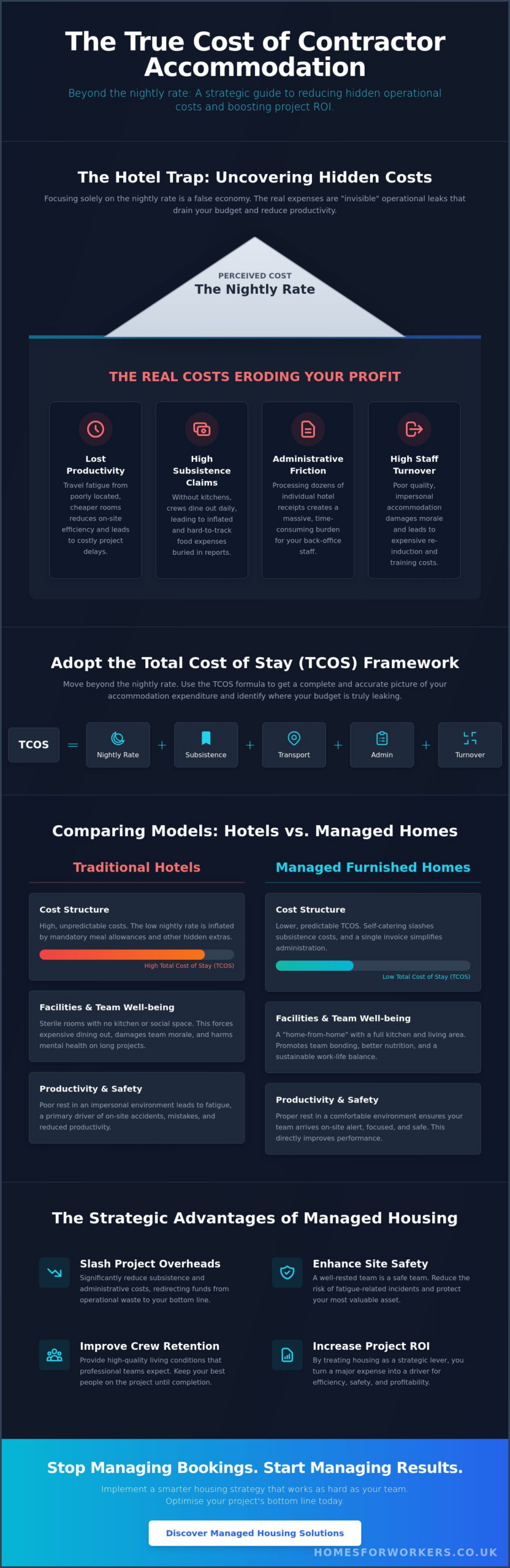
Nightly rates are deceptive. They are only the tip of the iceberg. The real “Hotel Trap” lies in the lack of facilities. Without a kitchen, your crew must dine out every night. This leads to high daily subsistence claims. These costs often go unmonitored because they are buried in individual expense reports. Then there’s the administrative drain. Processing dozens of individual receipts from multiple hotels is a massive burden for your back-office team. It creates friction. It wastes time. It’s an inefficient way of managing a workforce.
The Relationship Between Rest and Site Safety
Fatigue is a primary driver of on-site accidents. Providing high-quality team accommodation is a safety measure. When workers rest in a quiet, “home-from-home” environment, they recover better than they would in a sterile hotel room. They arrive on-site alert and ready. The financial impact of a single health and safety incident can be catastrophic. It leads to investigations, fines, and halted work. Sourcing specialised housing is a more effective method of reducing contractor accommodation costs than relying on the fluctuating prices of the local hotel market. Professional teams prefer the autonomy of a house. They can cook their own meals and relax in a private living space. This sense of normality is vital for maintaining mental health during long projects.
The Total Cost of Stay (TCOS) Framework
Nightly rates provide an incomplete picture. They ignore the operational reality of housing a workforce. To achieve genuine progress in reducing contractor accommodation costs, you must adopt the Total Cost of Stay (TCOS) framework. This formula accounts for every pound spent from the moment a booking is made until the team leaves the site. The calculation is simple: (Nightly Rate x Stays) + Subsistence + Transport + Admin + Turnover. By looking at the complete picture, you identify where your budget is actually leaking.
Location leakage is a common culprit. If a property is cheap but adds 30 minutes to the daily commute, you are paying for fuel and lost labour. This often exceeds the “savings” on the room. Similarly, subsistence costs can spiral when teams rely on hotel restaurants. While benchmarks like federal per diem rates provide a baseline for lodging and meals, they often assume expensive dining out. A strategic housing plan cuts these costs at the source.
Calculating the Subsistence Savings of Self-Catering
Food is a major variable in your project overheads. A crew of four staying in a hotel will typically require significant daily allowances for breakfast, lunch, and dinner. In contrast, fully furnished homes provide private kitchens. This allows teams to prepare their own meals. The savings are immediate. Beyond the financial benefit, healthy, home-cooked meals improve long-term morale. Your team stays healthier. They feel more settled. This reduces the risk of burnout and helps in reducing contractor accommodation costs through lower staff turnover. Kitchen access effectively eliminates the need for inflated subsistence payments.
Quantifying Administrative and Logistics Costs
Admin friction is an often-overlooked expense. Your back-office team spends hours sourcing properties, managing amendments, and chasing individual receipts. This is a high-cost activity. Sourcing managed stay services removes this burden entirely. Consolidated invoicing replaces dozens of messy hotel bills with a single, clear document. This streamlines your accounting processes. A single point of contact also reduces operational friction. When a project timeline shifts, you make one call instead of ten. This efficiency allows your project managers to focus on site delivery rather than logistics.
Comparing Models: Why Fully Furnished Homes Beat Hotels
Hotel pricing is fundamentally inefficient for teams. Booking three separate rooms for a crew of three is a significant budget drain. You pay for three sets of overheads and three sets of cleaning fees. A single three-bedroom house consolidates these costs into one manageable figure. The per-head saving is immediate. With global hotel rates projected to hit an average of $172 in 2026, the cumulative cost of individual rooms becomes unsustainable for long-term projects. Choosing a house is a straightforward method for reducing contractor accommodation costs whilst providing a superior standard of living.
Flexibility is another key differentiator. Hotels rely on rigid cancellation policies. If a site closes due to weather or a project phase finishes early, you often face non-refundable charges. Managed housing and short-term lets allow for more agile arrangements. You can negotiate stays that align with your specific project milestones. This avoids the waste of paying for empty rooms. It’s about matching your housing spend to your actual site activity. When you control the booking duration, you control the budget.
There is also a social dividend to consider. Living as a team improves communication. It builds a level of camaraderie that a sterile hotel corridor cannot replicate. Evening debriefs happen naturally in a shared kitchen or living room. This social cohesion translates to better site performance. It reduces friction amongst the crew. When workers feel settled together, they’re less likely to leave the project. This protects you from the high costs of recruitment and re-induction that follow high staff turnover.
Space and Utility: More Than Just a Bed
A hotel room is just a bed. A house is a functional workspace. Separate living areas allow for informal team meetings and evening relaxation. Laundry facilities are a critical but often overlooked cost-saver. They eliminate the high fees of hotel dry cleaning services. They also save the time workers would otherwise spend at off-site launderettes. High-speed Wi-Fi is now a standard requirement for professional workforces. It ensures your team stays connected for digital reporting and personal downtime without the hidden premium charges often found in hospitality settings.
Security and Parking for Contractor Vehicles
Unsecured hotel car parks are a magnet for tool theft. Losing a van full of equipment is a massive financial blow. It causes immediate project delays and triggers insurance premium hikes. Sourcing contractor accommodation with private driveways or secure perimeters is a practical security measure. It’s a non-negotiable requirement for teams carrying expensive plant and equipment. Gated properties or houses with off-street parking provide the security that standard hotels simply cannot offer. This proactive approach protects your project assets and your bottom line.
5 Steps to Organise Cost-Effective Team Housing
Efficiency on a major infrastructure project requires a methodical approach to logistics. You cannot leave housing to chance. Follow these five steps to ensure you are reducing contractor accommodation costs without sacrificing site safety or team morale. A structured plan removes the guesswork from your budget.
- Step 1: Audit your current spend. Identify where the “leaks” are occurring. Check for inflated subsistence claims, excessive travel time, and the administrative hours spent on messy booking amendments.
- Step 2: Define your “Radius of Efficiency”. Find the sweet spot between property price and commute time. A cheaper house 45 minutes away often costs more in fuel and lost labour than a premium property five minutes from the site.
- Step 3: Transition to corporate housing for teams. Move away from individual hotel rooms. Consolidated housing reduces the per-head cost and simplifies your entire logistical chain.
- Step 4: Standardise your “Crew Comfort” requirements. Ensure every property provides high-speed Wi-Fi, laundry facilities, and secure parking. Consistency prevents staff turnover and maintains site productivity.
- Step 5: Partner with a specialist provider. Outsource the management burden. Let experts handle the sourcing, vetting, and invoicing so your project managers can focus on delivery.
Auditing Your Historical Accommodation Data
Data is your best tool for reducing contractor accommodation costs. Review your previous projects to identify overspending patterns. You’ll likely find that last-minute booking habits carry a 20% to 30% premium. Use these insights to negotiate better rates for upcoming long-term durations. When you can prove your stay requirements in advance, you gain significant leverage with housing providers. Identifying the true cost of “admin friction” also helps justify the move to a more streamlined, managed solution.
Optimising for Long-Term Project Durations
National infrastructure works often span several years. This provides a unique opportunity for budget certainty. Booking 3-6 months in advance allows you to secure the best properties before the local market peaks. For projects with fluctuating crew sizes, negotiate “stay-pay” models. These allow for flexibility whilst maintaining a fixed-term baseline. Fixed-term managed housing is particularly valuable during the tender stage. It provides a concrete figure for your bids, protecting your margins from the volatility of the hospitality sector. If you want to secure budget certainty for your next project, consider our Managed Stay Services.
Scaling Efficiency with Managed Stay Services
Managed services function as a force multiplier for project teams. They take complex logistical puzzles and solve them before they reach the project manager’s desk. This level of professional oversight is essential for reducing contractor accommodation costs on large-scale operations. Local expertise is a vital component of this service. Sourcing suitable properties near remote or difficult-to-access sites requires boots-on-the-ground knowledge. A standard booking engine cannot account for local traffic patterns or the specific security needs of a utility crew. Expert sourcing ensures your team is positioned for maximum site efficiency.
Speed is often a project’s biggest hurdle. We facilitate rapid deployment to meet tight deadlines. Getting a 10-man crew housed in 48 hours is a standard operational requirement for modern infrastructure projects. Professional management ensures that these quick turnarounds don’t result in sub-standard living conditions. Maintenance is handled proactively through our Managed Stay Services. This prevents project disruptions caused by boiler failures or utility issues. When the housing works, the project stays on schedule.
Removing the Administrative Burden from Project Teams
Project managers must focus on site delivery. They shouldn’t be chasing keys or vetting individual landlords. Outsourcing housing management removes this entire administrative layer. For a 12-month project stay, your accounting department receives a single, consolidated invoice. This replaces hundreds of messy receipts and individual expense claims. Managed services also handle the “unforeseen”. If a project phase is extended or a property requires urgent repair, the provider resolves the issue immediately. You maintain momentum without the distraction of housing logistics.
Future-Proofing Your Workforce Strategy for 2026
The UK hospitality market is evolving. Traditional hotel costs are rising whilst availability is tightening near major industrial hubs. Adapting your strategy now is critical for reducing contractor accommodation costs over the next few years. Top-tier contractors already use quality staff accommodation as a recruitment tool. It attracts the best talent in a competitive labour market. Providing a stable, private home shows you value your workforce. This leads to higher retention and better site performance. Ultimately, investing in professional housing solutions is a direct investment in project margin protection. It ensures your team is rested, your admin is lean, and your budget remains secure against market volatility.
Secure Your Project Margins for 2026
Success in modern infrastructure delivery requires logistical precision. You’ve seen how the Total Cost of Stay (TCOS) framework reveals the true impact of “invisible” expenses like subsistence and travel time. Moving away from expensive, sterile hotel stays is the most effective strategy for reducing contractor accommodation costs whilst protecting your bottom line. By prioritising fully furnished homes with secure parking, you ensure your workforce stays rested, safe, and productive throughout the project lifecycle.
Managing these details shouldn’t be a burden for your back-office team. We provide a fully managed service from initial sourcing to ongoing maintenance. As specialists in UK-wide team accommodation, our solutions are designed specifically for the needs of professional contractor workforces. Streamline your project logistics with Homes For Workers and gain the peace of mind that every detail is being managed by experts. Start building a more resilient and cost-effective housing strategy today.
Frequently Asked Questions
How can I reduce contractor accommodation costs on short-term projects?
Focus on local property sourcing rather than national hotel chains. Use the “Radius of Efficiency” to find housing close to the site to minimise fuel and labour costs. Avoid individual room bookings which carry a hospitality premium. Managed stays provide the flexibility needed for short durations without the rigid cancellation fees of traditional hotels. This approach ensures you aren’t paying for empty rooms when site schedules shift.
Are serviced houses really cheaper than budget hotels for teams?
Serviced houses are significantly more cost-effective when calculated on a per-head basis for crews of three or more. A single house consolidates cleaning fees, utility overheads, and parking into one price. This is a primary method for reducing contractor accommodation costs compared to booking multiple budget rooms. You also avoid the “Hotel Trap” of expensive on-site dining and laundry services that quickly erode your project budget.
What are the biggest hidden costs in contractor travel and housing?
Travel fatigue and the “subsistence gap” are the most significant invisible drains on your margin. Fatigue leads to diminished site productivity and increased safety risks. The subsistence gap occurs when teams lack cooking facilities and must claim for expensive restaurant meals. Administrative friction is another hidden cost. Your back-office team spends hours processing messy receipts instead of focusing on high-value tasks. These factors often exceed the nightly room rate.
How does self-catering affect my project budget?
Self-catering facilities drastically lower your daily subsistence allowances. Providing a private kitchen allows teams to prepare their own meals, which can save a substantial amount per person every day. It also improves workforce health and morale by moving away from processed hotel food. This leads to a more alert and settled crew. Lowering these daily “per diem” payments is a pragmatic way of reducing contractor accommodation costs over the long term.
Is it better to book multiple rooms or one large house for a crew?
One large house is almost always superior for professional contractor crews. It fosters better team communication and provides essential amenities like private laundry and shared living spaces. Houses also offer more secure parking for vans and expensive equipment. This reduces the risk of tool theft which is common in unsecured hotel car parks. A shared home environment creates a “home-from-home” feel that hotels simply cannot replicate.
How do I manage accommodation for a project that keeps getting extended?
Partner with a specialist provider that offers flexible managed stay services. They can negotiate extensions with landlords and ensure continuity of housing for your team. This avoids the stress of re-booking and moving crews between different locations at short notice. Managed services act as a buffer between your project team and the property market. They handle the logistics of shifting timelines so your site delivery remains on track.
What should I look for in a contractor housing provider?
Look for a provider with UK-wide coverage and a single point of contact. They should offer fully managed services, including maintenance, vetting, and consolidated invoicing. This removes the administrative burden from your project managers. Ensure they understand the specific needs of contractor workforces, such as high-speed Wi-Fi and secure parking. A dedicated partner should act as a “behind-the-scenes fixer” that handles the heavy lifting of logistics.
Can managed stay services help with VAT recovery on accommodation?
Managed services simplify the VAT recovery process by providing clear, consolidated invoices. This replaces the need to chase dozens of messy hotel receipts which are often difficult for accounting departments to process. A single, professional invoice ensures your tax reclaims are accurate and efficient. This streamlines your financial reporting and ensures you aren’t missing out on legitimate tax recoveries due to poor documentation from multiple hospitality providers.