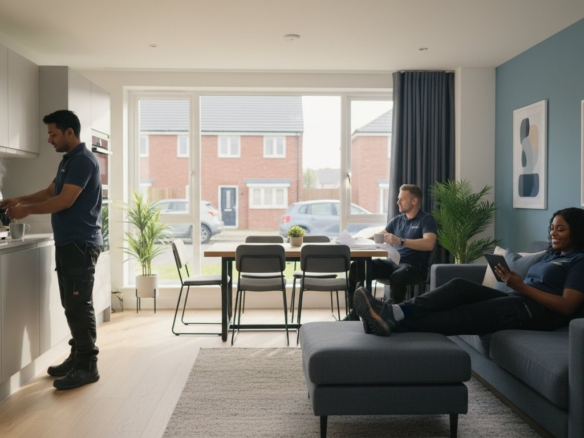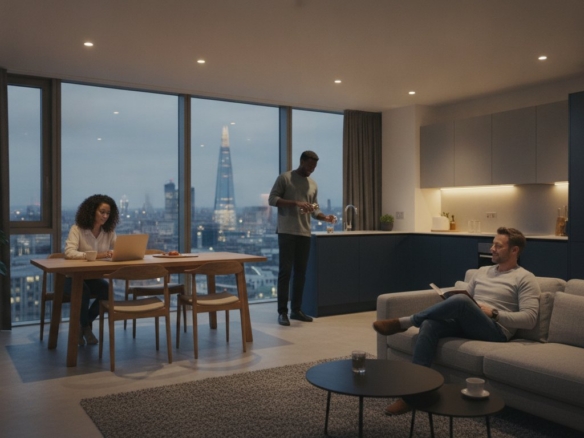


Choosing a block of hotel rooms for your next infrastructure project isn’t just an expense. It’s a risk to your delivery timeline. You already know the logistical strain of rising nightly rates. You’ve likely felt the administrative burden of managing multi-bedroom contractor accommodation needs through fragmented bookings. When your team faces cramped living conditions and the daily struggle for secure van parking, morale drops. Productivity follows. It’s a cycle that leads to avoidable project delays.
Transitioning to fully furnished homes transforms your housing strategy from a cost centre into a strategic asset. You deserve a solution that provides your workforce with genuine comfort whilst simplifying your invoicing into a single, manageable stream. This guide explores how moving away from traditional hotels lowers your cost-per-head, improves team cohesion, and provides the flexibility needed to keep your UK project moving forward without the usual friction.
Key Takeaways
- Realise 30-50% savings on project budgets by switching from fragmented hotel bookings to a streamlined single-invoice model.
- Discover why multi-bedroom contractor accommodation outperforms hotels by providing essential facilities like full kitchens and private laundry.
- Scale your housing strategy effectively by matching bed-counts to project milestones through phased deployment.
- Reduce your administrative burden by utilising managed stay services that handle property vetting and quality control.
- Improve workforce retention by providing teams with the space and privacy of fully furnished homes instead of cramped hotel rooms.
What is Multi-Bedroom Contractor Accommodation?
Modern project delivery relies on more than just site equipment. It requires a stable, high-functioning workforce. Multi-bedroom contractor accommodation provides professional teams with fully furnished residential properties for their exclusive use. Unlike a standard hotel stay, these homes offer a self-contained environment where crews can live, cook, and recover. This housing model shares many operational similarities with corporate housing, yet it is specifically engineered to meet the logistical demands of construction and infrastructure sectors.
The shift away from individual hotel rooms is driven by a need for better team cohesion. Project managers are moving towards communal housing solutions that offer more than just a bed. A house provides a functional kitchen, private living areas, and the ability to socialise as a single unit. This environment supports better mental health and reduces the friction of long-distance deployments. By 2026, project standards have evolved. Success is now measured by workforce well-being and the ability to maintain a consistent team throughout the project lifecycle.
Key Characteristics of Contractor-Grade Housing
Exclusive occupancy is the primary differentiator. Your crew doesn’t share the property with members of the public or other contractors. This level of privacy is essential for security and team focus. The interiors are professionally furnished with durable, high-quality materials designed for long-term stays. These aren’t standard domestic rentals; they are managed assets. Strategic location is also vital. Properties are selected for their proximity to major UK infrastructure hubs and motorway networks. This reduces commute times and ensures your team arrives on site ready to work. Secure parking for large work vehicles is a standard requirement, removing a common logistical headache for project leads.
The Evolution of Workforce Housing in the UK
The era of informal “digs” has ended. Professionalisation is the new industry standard. New 2026 regulations, including the mandatory National Registration Scheme in England and the Visitor Accommodation Register in Wales, have formalised the sector. These schemes ensure every property meets strict safety and quality benchmarks. Duty of care is now a central pillar of accommodation strategy. Modern multi-bedroom contractor accommodation also addresses the digital needs of the site office. High-speed Wi-Fi is a baseline requirement, not an extra. It allows supervisors to complete digital reporting and administration from home, bypassing the need to stay late at the site office. This evolution reflects a broader trend: treating housing as a strategic project asset rather than a simple line-item expense.
The Functional Advantages of Whole-House Stays for Teams
Choosing a whole-house stay over a hotel block isn’t just about bed counts. It’s about operational capacity. A multi-bedroom contractor accommodation unit functions as a secondary site office and recovery hub. It provides the infrastructure your crew needs to maintain peak performance throughout a long-term deployment. When a team can “close the front door” on a work day, the psychological shift from site to home happens instantly. This transition is vital for preventing burnout on demanding UK infrastructure programmes.
Kitchens as a Cost-Saving Engine
A kitchen is more than a room. It’s a cost-saving engine. Relying on hotels often forces workers into a “hotel food tax” where every meal is purchased at hospitality margins. This can add significant pressure to project budgets. By providing full kitchen access, you empower your team to self-cater. This leads to better nutrition and improved sleep patterns, which directly enhances site safety. You should review the UK government rules on accommodation expenses to see how these provisions impact your reporting. The subsistence ROI of a fully equipped kitchen is found in the direct replacement of high-margin hospitality pricing with controlled, wholesale grocery costs.
The Importance of Communal Space and Privacy
Privacy is a retention tool. Modern workforce housing must respect individual space to reduce interpersonal friction. Separate bedrooms allow workers to decompress without the intrusion of twin-sharing. Meanwhile, the communal living area serves as a natural “debrief zone” for project leads. It’s where the next day’s logistics are often quietly ironed out over a coffee. Securing fully furnished homes through a managed provider ensures these functional benefits are standard across every project location.
The practicalities of multi-bedroom contractor accommodation also solve the “van problem” that plagues town-centre hotels. Most residential houses offer:
- Secure, off-street parking for multiple commercial vehicles and vans.
- Full laundry facilities essential for crews working in wet or demanding outdoor environments.
- Dedicated utility spaces for drying high-vis gear and storing PPE.
- Ample fridge and freezer capacity for weekly team meal prep.
These features remove daily friction. Your workers don’t spend their evenings hunting for a laundrette or a safe parking space three streets away. They focus on the job. This streamlined approach to living translates directly into a more focused, reliable workforce on site.
Comparing Multi-Bedroom Houses vs. Hotel Blocks: The ROI Equation
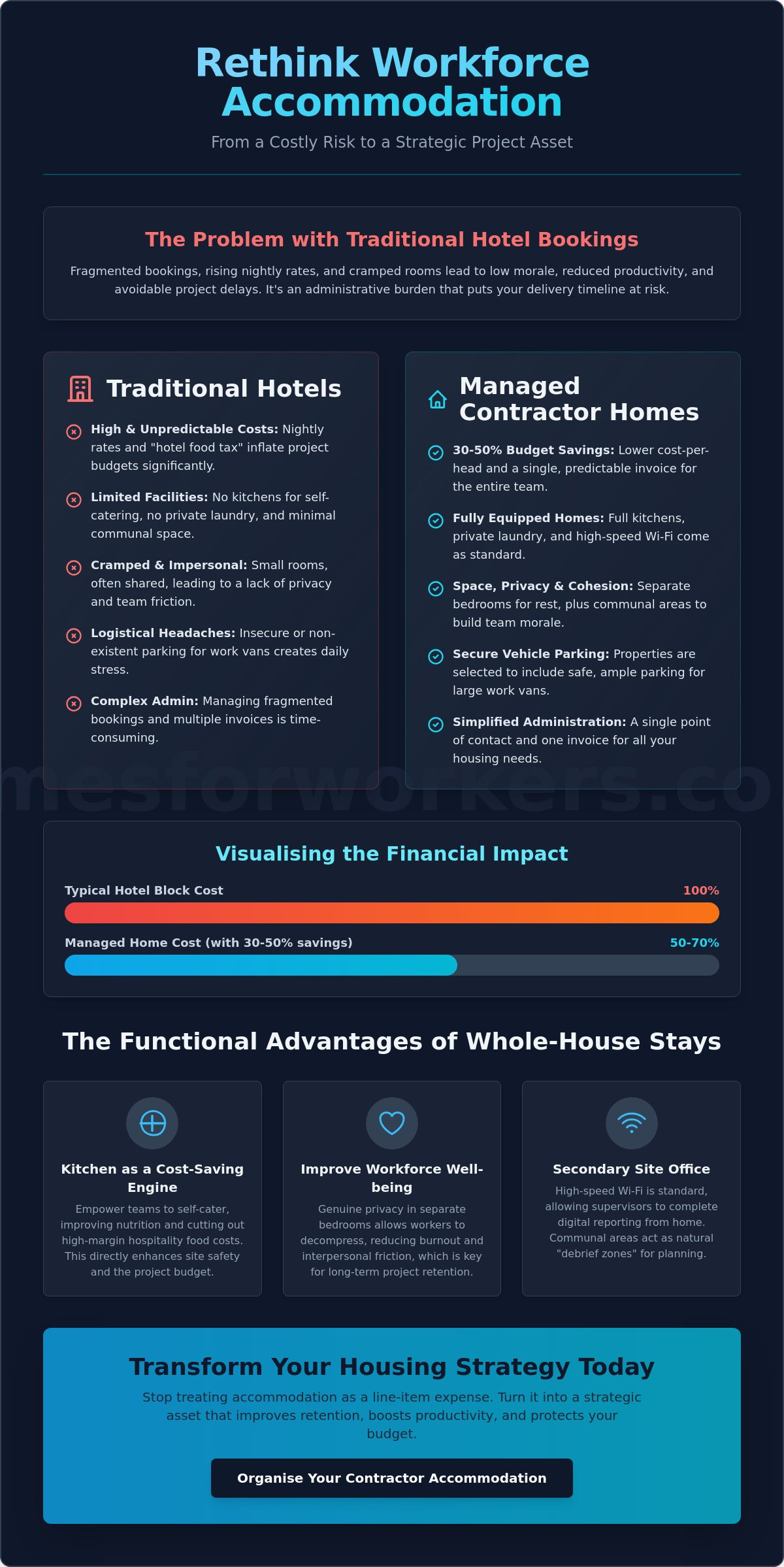
Treating accommodation as a simple line item often leads to project overruns. The real ROI of multi-bedroom contractor accommodation is found in the total cost of deployment, not just the nightly rate. On long-term projects, switching from hotel blocks to managed houses typically yields savings of 30-50% per head. These figures reflect more than just lower rent. They represent the removal of hospitality markups and the streamlining of project logistics.
Administrative efficiency is a primary driver of these savings. Managing a dozen individual hotel bookings creates a significant burden for your back-office team. One house requires one invoice. This consolidated approach saves hours of administrative time every month. It also simplifies the process of organising effective workforce housing in 2026, allowing project managers to focus on site delivery rather than booking confirmations.
The Hidden Costs of Hotel Stays
Hotels often carry invisible expenses that erode project budgets. City centre car parks frequently have van-height restrictions, leading to costly parking fines or the need for off-site storage of vehicles. Laundry service markups and a lack of healthy food options also inflate subsistence claims. Beyond the balance sheet, “hotel fatigue” is a genuine risk. It manifests as decreased morning productivity and slower site start times. Providing a residential environment helps maintain a consistent work rate by ensuring the crew is properly rested and fed.
Calculating the Real Value of Managed Housing
Direct cost savings are easiest to quantify when comparing rent against room rates over a six-month project duration. However, the indirect gains are often more valuable. High-quality housing reduces staff turnover. Replacing a skilled contractor mid-project is an expensive and time-consuming process that can derail a timeline. Adhering to HSE guidance on worker accommodation ensures you meet your duty of care, which is essential for workforce stability. When workers feel their living conditions are respected, they are more likely to remain on the project until completion. This stability is the foundation of a successful, on-time delivery.
Reliable housing creates a predictable environment. It removes the daily stresses of finding parking or searching for a laundrette. Your team stays focused on their primary objectives. This reduction in absenteeism and improvement in morale creates a more resilient project workforce. By choosing managed houses, you are investing in the reliability of your most important asset: your people. Teams working on wind farms, solar installations, and other remote sites can find specific guidance on renewable energy project accommodation that addresses the unique logistical challenges of those environments.
Best Practices for Organising Multi-Bedroom Stays Across the UK
Effective logistics are the backbone of site productivity. Organising multi-bedroom contractor accommodation requires a proactive approach to bed-count management. Phased deployment ensures your housing costs mirror your workforce scaling. You don’t want to pay for a six-bedroom house when only four workers are on site during the initial mobilisation. Conversely, you cannot risk a housing deficit during peak construction phases. Aligning your booking schedule with your project milestones is essential for tight budget control.
Vetting your provider is equally vital. A professional managed stay partner understands that “contractor-grade” means durable and functional. They should provide clear documentation and transparent reporting. A robust check-in protocol ensures your team is settled and ready for the morning briefing. This includes providing digital welcome packs that cover Wi-Fi access, parking, and local amenities before the crew arrives. Frictionless access via smart locks or lockboxes is the standard for 2026, allowing teams to arrive on their own schedule without logistical delays.
Evaluating Property Suitability
Bedroom configurations matter. Aim for single-occupancy whenever possible. It’s a professional standard that reduces burnout and keeps morale high amongst the crew. Connectivity is another baseline requirement. Robust Wi-Fi allows for seamless project reporting and keeps workers connected to their families. Your location strategy must be pragmatic. Proximity to the site is the priority, but don’t ignore the need for supermarkets and local shops. A remote house with no nearby services adds unnecessary stress to a tired team. For a deeper dive into these variables, see our Team Accommodation: The Complete Guide to Workforce Housing in 2026.
Managing the Logistics of a Team Stay
Clear “House Rules” protect your company’s reputation. They set expectations for noise, waste management, and property care. Professional cleaning is a necessity for long-term stays. It ensures the environment remains healthy and professional. You also need a single point of contact for maintenance. When a boiler fails or a key is lost, your project leads shouldn’t be the ones solving the problem. Outsourcing this to managed stay services allows your team to focus exclusively on project delivery. This “fixer” approach removes the administrative heavy lifting from your site office, ensuring that maintenance issues are resolved without interrupting the project timeline.
Scaling Your Project with Homes For Workers Managed Housing
Scaling a project across multiple UK locations requires more than just a booking engine. It requires a dedicated housing partner. Homes For Workers provides a nationwide network of multi-bedroom contractor accommodation with consistent standards from Penzance to Perth. This geographic reach ensures your team experiences the same quality of living regardless of the project site. We act as your behind-the-scenes fixer. We handle the logistical heavy lifting so you don’t have to.
Professional management beats DIY property sourcing every time. Finding, vetting, and managing individual residential properties is a significant drain on your internal resources. It leads to fragmented communication and administrative friction. Our managed stay services remove these burdens. We offer flexible terms that allow you to adjust your housing footprint as project requirements evolve. Whether you’re mobilising a new crew or winding down a phase, our housing solutions scale with you.
Simplified Management for Large-Scale Projects
Complexity shouldn’t be the default for large-scale deployments. We simplify your back-office operations through single-point invoicing. Even if your project spans multiple properties across different UK regions, you receive a consolidated, clear statement. This saves your accounts department hours of reconciliation work. You also benefit from dedicated account management. We handle rapid deployments and crew changes with operational urgency. Our team takes a proactive approach to maintenance. We identify and fix property issues before they impact your workforce’s productivity or morale. This reliability is why project managers trust us as their stable partner in fast-moving environments.
Your Partner in Workforce Retention
A project is only as strong as its workforce. High staff turnover is an expensive risk that often stems from poor living conditions. We focus on creating environments where contractors actually want to stay. This isn’t just about comfort; it’s about respect for their professional needs. Our ‘Ready-to-Occupy’ standard ensures your team can move in and start work immediately. There are no settling-in delays or missing essentials. Everything is organised to maintain project momentum from day one. By providing high-quality multi-bedroom contractor accommodation, you demonstrate a commitment to your team’s well-being. This investment pays dividends in loyalty and site performance. Contact Homes For Workers to discuss your next project’s housing needs and secure the stability your delivery timeline requires.
Secure Your Project Workforce Today
Transitioning from hotel blocks to multi-bedroom contractor accommodation is a strategic move that protects your project’s ROI. You’ve seen how dedicated housing reduces administrative friction whilst improving team cohesion on site. By prioritising functional spaces like full kitchens and private laundry, you remove the daily stressors that lead to workforce burnout. This stability is essential for meeting tight UK delivery timelines without the risk of project overruns.
Homes For Workers specialises exclusively in workforce housing. We don’t handle individual residential lets. This specialist focus allows us to provide comprehensive managed stay services with consistent standards across the UK. Our national coverage ensures that your team is supported from mobilisation through to completion. We handle the heavy lifting of property vetting and maintenance so you can focus on site delivery. It’s time to stop managing bookings and start managing your project. Request a Tailored Quote for Your Team’s Next Project today and experience the peace of mind that comes from professional housing management.
Frequently Asked Questions
What is included in multi-bedroom contractor accommodation?
Our multi-bedroom contractor accommodation includes all utility bills, high-speed Wi-Fi, and professional cleaning services as standard. Every property is equipped with a full kitchen, laundry facilities, and bed linens. This ensures your team can move in and start work without managing separate utility accounts or domestic logistics. We provide the essential infrastructure so your crew can remain self-sufficient throughout their stay.
How many contractors can stay in one multi-bedroom house?
Capacity depends on the specific property size and bedroom configuration. Most houses accommodate between three and six workers whilst maintaining the professional standard of single-occupancy bedrooms. We match the property to your specific crew size to ensure everyone has sufficient private space and access to communal facilities. This approach reduces interpersonal friction and supports better workforce retention.
Is parking for large vans typically available with these properties?
We prioritise properties that offer secure, off-street parking or ample roadside space suitable for large commercial vans. This removes the risk of parking fines and height restriction issues common with city-centre hotels. We vet each location specifically for vehicle accessibility before confirming your booking. Your team won’t waste time searching for safe places to leave their tools and equipment overnight.
Are these properties fully furnished and ready for immediate use?
Every home is provided as a fully furnished, “ready-to-occupy” asset. This means beds are made, kitchens are stocked with essential appliances, and living areas are set up for immediate use. Your team can settle in on day one without any delays to your project schedule. We ensure the transition from site to home is as seamless as possible for your workforce.
How do multi-bedroom houses compare to hotels in terms of price?
Managed houses typically offer a lower cost-per-head than hotel blocks, especially on long-term deployments. Savings are realised through reduced nightly rates and the elimination of expensive hospitality subsistence costs. You also benefit from simplified invoicing. This reduces the administrative hours spent on back-office reconciliation. It’s a more efficient use of your project budget over the total deployment duration.
Can we book contractor housing for short-term projects?
Yes, we provide flexible short-term stays for projects lasting only a few weeks. Whilst many clients use our homes for multi-month infrastructure works, we can accommodate shorter site mobilisations or specialist crew visits. Our managed stay services are designed to adapt to your changing project requirements. You get the same professional standards regardless of the length of the stay.
Who is responsible for the maintenance of the property during our stay?
We handle all property maintenance and emergency repairs through our managed stay services. Your project managers don’t need to coordinate with tradespeople or solve domestic issues. If a boiler fails or a maintenance problem arises, our team manages the resolution. This ensures your workforce remains productive and settled without your site leads being distracted by property management tasks.
Do you provide multi-bedroom accommodation across the entire UK?
We provide multi-bedroom contractor accommodation across the entire UK. Our network covers major infrastructure hubs and commercial centres from Penzance to Perth. This nationwide reach allows you to maintain consistent housing standards across multiple project locations through a single partner. We act as your stable fixer, providing reliable housing solutions wherever your next project takes you.